Most "best Linktree alternatives" lists rank tools by feature count. That's the wrong question to ask, and it's why most of them lead you to the wrong tool.
A bigger feature list doesn't tell you what the tool will let you do five years from now, when your audience is bigger, your monetization is more complicated, and AI agents are doing half your work.
This guide skips the rankings. Instead it gives you three questions to ask about any link-in-bio tool, and then walks through the major options honestly -- including ours.
The three questions to actually ask
Linktree solved a specific 2016 problem: you have one bio link slot and many things to share. A list of links solves that. The reason "Linktree alternatives" keep getting written is that the original problem has gotten bigger. Audiences are spread across more platforms. Creators are running businesses, not just gathering followers. AI is starting to do real work on creators' behalf.
A bio link tool that solves only the original 2016 problem will keep working -- but it'll cap what you can build on top of it. The questions that actually matter:
1. Does the tool give you an identity, or just a page?
A page is a static thing rendered when someone visits a URL. An identity is a graph: every short link, every verified social, every booking, every product you list -- all stored against one record that represents you. The difference matters when you grow. A page doesn't carry your social proof from one surface to another. An identity does.
Test for this: if you verify your Instagram on the platform, does that verification show up anywhere other than your bio page? On a page-only tool, no. On an identity tool, yes -- your short links, your discovery profile, your Hire Me listing all inherit the verification.
2. Does the tool make you discoverable, or just reachable?
Reachable means people can visit your URL if they have it. Discoverable means people who don't have your URL can find you anyway, by searching for what you do.
Most link-in-bio tools optimize for reachability. You give the URL out, people click it, that's the loop. A few are starting to add discovery layers -- directories, search, recommendations -- that route audience back into the platform instead of just out of it.
Test for this: search "best [your niche] creators" on the tool itself. If you don't show up -- and there's no mechanism for you to show up -- the tool isn't doing discovery. It's just a public page.
3. Can the tool be operated by something other than you?
This is the question almost no comparison list asks. In 2026, there are real AI agents -- Claude, ChatGPT, Cursor, Perplexity -- that can take instructions and act on services on your behalf. The question isn't whether the tool has an API. Most do. The question is whether the API is built for agents specifically, with their own auth, their own rate limits, their own audit trail, and the ability to actually do things -- create links, update profiles, complete purchases -- without sharing your password.
Test for this: can you give an agent a token that lets it create a new link for you, but not delete your existing ones? On most tools, no. The agent gets your full session credential or nothing.
Use those three thresholds when evaluating anything below.
The major tools, grouped honestly
Most "best Linktree alternatives" lists treat all the tools as direct comparisons. They're not. They're solving different problems. Here's how they actually break down.
Bio-page tools (Linktree, Beacons, Stan)
Descendants of the original Linktree concept. A page with links. They've added theming, analytics, and sometimes monetization. They don't shorten URLs, they don't have creator discovery layers that meaningfully send traffic back to you, and they don't have agent-tier APIs.
Linktree -- still the most recognized brand. Free tier exists but charges 12% commerce fees on sales (9% on paid plans, 0% only at the $35/mo Premium tier). Pro is $15/mo. Strong on integrations, weak on differentiation. If you want a page and you want the brand recognition, this works. If you want anything beyond a page, look elsewhere.
Beacons -- leaning hardest into creator monetization. Has an AI assistant called Beam that handles brand outreach, content drafting, and email marketing. Creator Pro is $10/mo. The strongest of the bio-only tools if monetization is your priority. Same structural limit though: it's a page, not an identity.
Stan -- focused specifically on selling digital products and bookings. Built-in storefront and scheduler. No free plan. If you primarily sell courses or coaching, this is more storefront than bio link. Use Stan for the store, something else for the bio.
Link infrastructure tools (Bitly, Dub.co, Short.io, Rebrandly)
These tools do short links and analytics extremely well. They're aimed at marketers and developers, not creators. None have bio page builders. None have creator discovery. Pairing them with a separate bio tool means you maintain two products.
Bitly -- the enterprise standard. Used by half the Fortune 500. Free tier is heavily restricted: 5 links per month, ads on redirect. Real plans start at $10/mo (Core) and scale to $300/mo (Premium). Pick Bitly if you're a large team that needs branded short links at scale. Don't pick it if you want bio pages or anything creator-flavored.
Dub.co -- open-source, developer-loved, used in production by Vercel, Supabase, Raycast, Tinybird, Midday, and Perplexity. 15K+ GitHub stars. Crossed $10M in affiliate program payouts in March 2026. Free tier is generous: 25 links per month, 3 custom domains. Pro is $25/mo. Has an "Ask AI" analytics feature and a community-built MCP server. Best-in-class for marketing attribution. Not a bio tool, doesn't pretend to be.
Short.io -- quiet but capable. $5/mo entry, generous free tier (1K branded links, 50K clicks/month). Strong API documentation. Picks up where Bitly's pricing gets unreasonable. Same limits -- infrastructure tool, not identity.
Rebrandly -- enterprise compliance angle (SOC 2, HIPAA). $11/mo entry. Pick this if your organization has regulatory requirements that exclude lighter tools. Otherwise priced and positioned for traditional marketing teams.
The hybrid attempt (Shorby)
Shorby has been trying to do bio + messaging-focused links for years. No free plan, frequently shifting pricing tiers. Specialized enough to recommend only if you specifically run a WhatsApp or Messenger funnel.
What's actually new (EdgeURL)
This is where the post stops pretending to be neutral. EdgeURL is the platform we build, so take what's below as positioning -- but the structural argument is the part that matters.
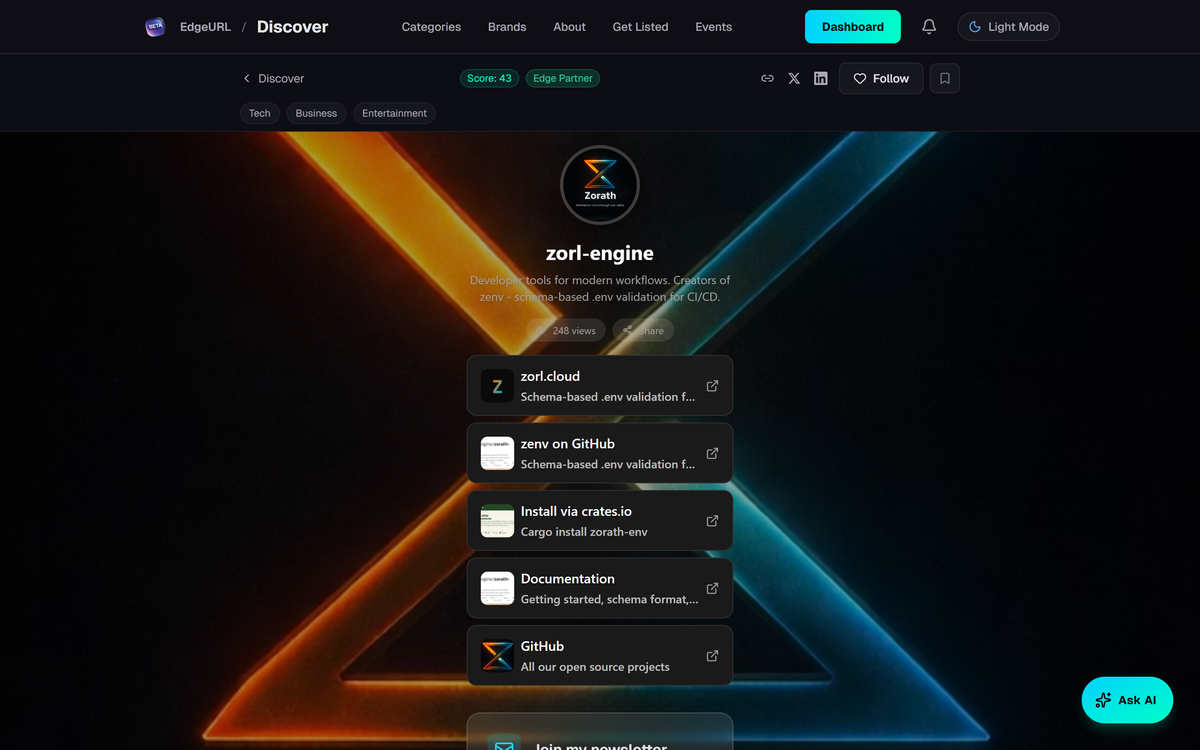
EdgeURL is built around the three-thresholds frame.
Identity: one record, every surface reads from it. Verify Instagram once and the badge propagates to your short links, Discover listing, Hire Me page, and bio.
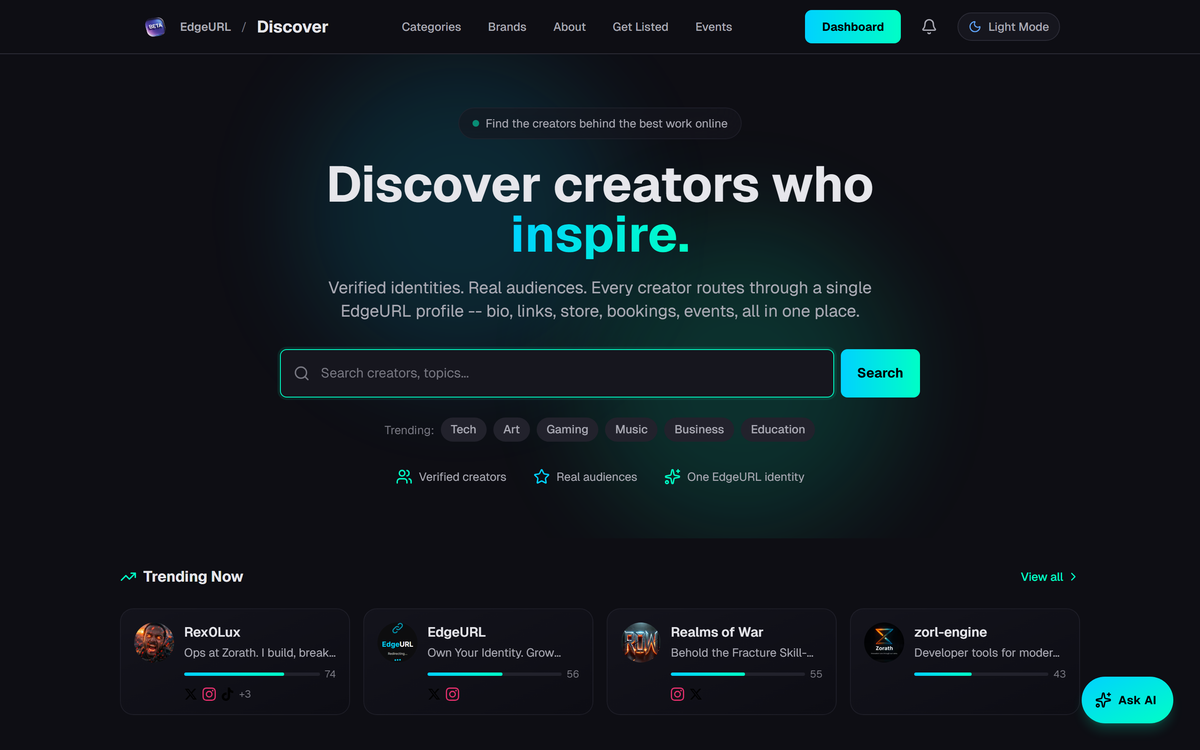
Discoverability: every published profile is indexed in a creator directory at edgeurl.io/discover. Verified socials raise your rank. Brands and clients searching for creators in specific niches surface you without cold outreach.
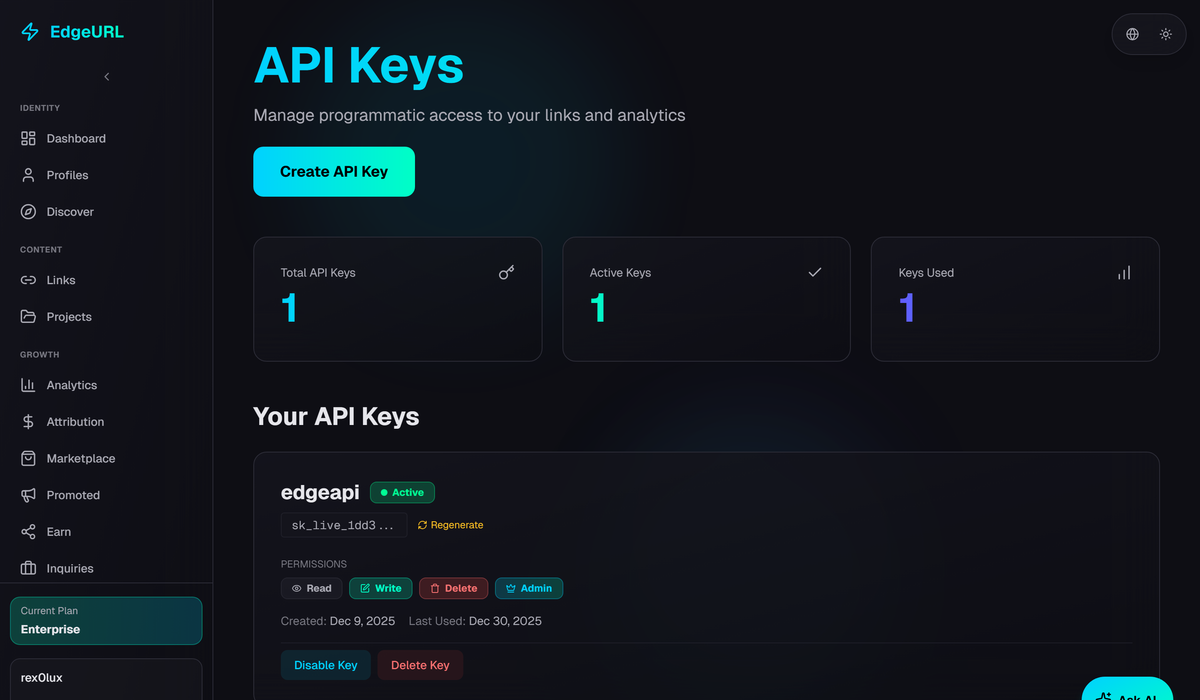
Programmability: a dedicated ai_* agent token tier at /api/ai/v1 with scoped permissions, BYOK across OpenAI, Anthropic, Google, Mistral, and Cohere, and full per-agent attribution. Free tier includes 5 agent actions per day so you can try it before committing.
The tool also does the things bio pages and shorteners do -- bio pages with custom domains, short links on the 0gr.me domain, real-time analytics, dynamic QR codes, A/B testing, webhooks, REST API. Free tier is 10 links and Bio Lite. Creator is $15/mo. Pro is $39/mo. Business is $149/mo with unlimited links.
What's packaged together that nobody else does: verified identity across 15 platforms (Instagram, X, TikTok, YouTube, LinkedIn, GitHub, Reddit, Threads, Facebook, Pinterest, Snapchat, Twitch, Medium, Substack, Spotify), a Hire Me marketplace with AI-drafted contracts and 85/15 Stripe payouts, a Discover directory that surfaces creators by category, and the agent API.
Newer than the rest. Less brand recognition than Linktree. Less developer mindshare than Dub. We ship fast -- v1.5.9, 680+ commits in four months, zero downtime in 90 days -- but velocity isn't a feature you can hold up alone.
How to actually decide
The right tool depends on what you're trying to build:
You're a casual creator with a small audience and a few links to share. Use Linktree's free plan. The brand recognition is real, the page works, you don't need anything else yet. Reassess in 6 months.
You sell digital products as your main income. Stan's storefront is strong. Pair it with a real bio tool if you also need a non-store landing page.
You're a marketing team running campaigns at scale. Dub or Bitly. Dub if you want the modern stack and partner program. Bitly if you need enterprise compliance.
You're a creator building a long-term audience and a business -- and you want what you build to last when AI agents are doing half the work. That's what EdgeURL is built for. The three-thresholds frame is the case for it; whether the case lands depends on whether you think identity, discoverability, and agent-readiness will matter to you in 2027 and beyond.
If they won't, pick something simpler.
If they might, pick EdgeURL while it's still early.
One concrete next step
Whatever you decide, do this today: audit the URL your bio link currently points to. Is it on someone else's domain (linktr.ee/yourname)? Every backlink from your social profiles is building their SEO, not yours. Move to a custom domain on whatever tool you pick. That single change compounds for years.
If you'd rather start fresh, create a free EdgeURL account, claim your handle, and verify one social. Takes about three minutes. The Discover indexing kicks in automatically.
Related reading: From Link-in-Bio to Social Identity Platform explains why we stopped calling EdgeURL a link tool. Link Hygiene: The SEO Practice 90% of Creators Ignore covers the redirects and custom domain piece in depth.
