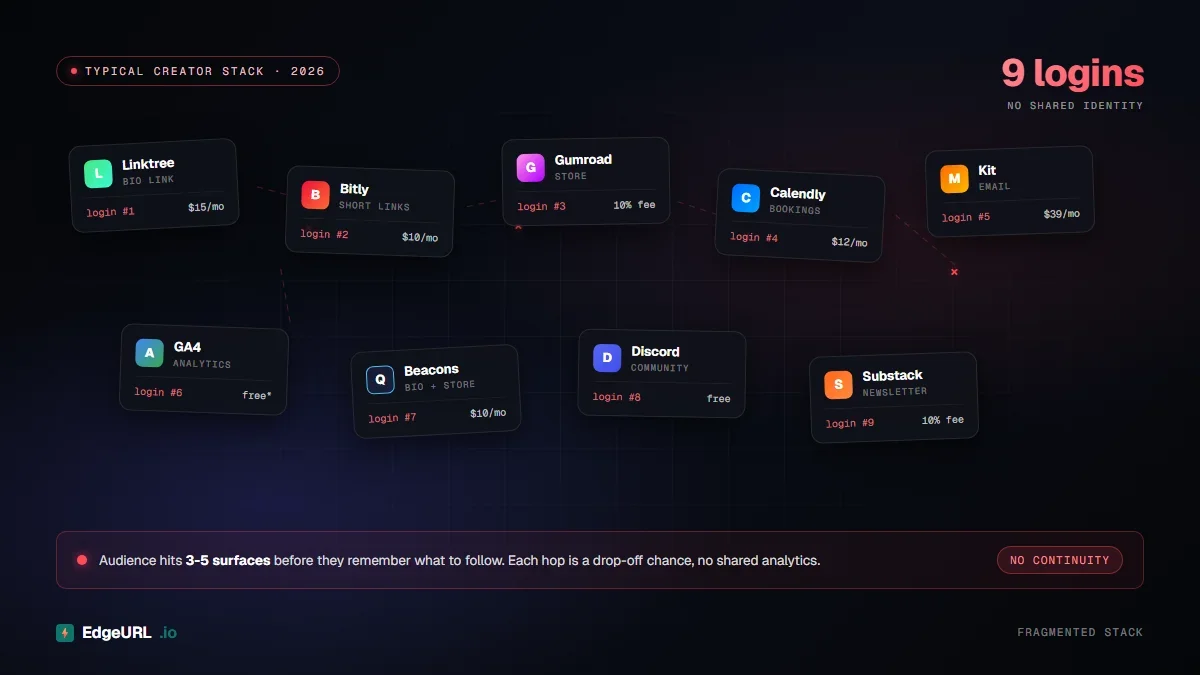
Audit a working creator's tool stack and you'll find a quietly absurd pattern: as many as sixteen separate products running in parallel to manage what is, structurally, one identity.
A typical creator now has a bio link tool, a URL shortener, an analytics dashboard, a storefront, a booking app, a QR generator, an email platform, a Substack, a Discord, a Patreon, a Stripe dashboard, a Notion publishing setup, a TikTok analytics view, a YouTube Studio, a Twitch dashboard, and a Hire Me / portfolio page. Each one has its own login. Each one has its own version of "you". Each one stores its own analytics that don't roll up anywhere.
The cost isn't the SaaS bill. It's that none of these tools talk to each other, so your identity has no continuity. Every surface re-creates "who is this person" from scratch, and the audience experience suffers in the same shape: they find you on TikTok, click your bio link to a Linktree page, click again to your Substack, and by the time they try to remember what to follow, the trail has gone cold.
This is the fragmentation problem, and it's not a UX gripe -- it's a structural reason most creator audiences don't compound the way the creator expects them to.
Why the fragmented stack happens
The fragmentation isn't because creators are disorganized. It's because every tool in the stack solves a single job-to-be-done, and they all came to market separately:
- 2016: Linktree solved "I have one bio link slot and many things to share"
- 2017: Bitly already existed for "I want to track which channel a click came from"
- 2019: Stripe and Gumroad solved "I want to sell something without a Shopify store"
- 2021: Calendly and Cal.com solved "I want clients to book me without email tag"
- 2023: AI-powered analytics tools solved "I want to know which posts drove sales"
Each tool nails its primitive. None of them know about the others. Stitching them together is the creator's job, and most don't realize they're paying for the stitching with audience drop-off and lost attribution.
What "one identity graph" actually means
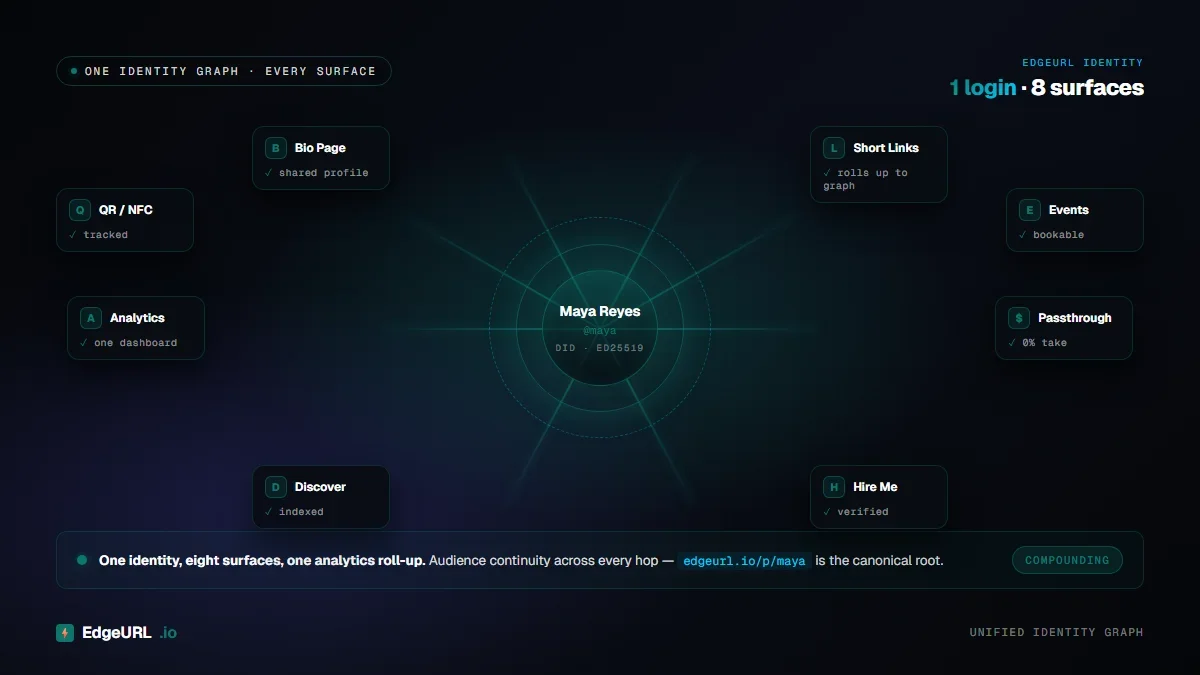
The identity-graph model is the structural alternative. Instead of sixteen tools each with their own user record, there's one identity record that surfaces in sixteen places.
Verify your Instagram once -- the verification badge shows on your bio page, ranks you higher on Discover, attaches to your Hire Me listing, and appears as a trust signal on every short link you create. You don't re-verify per surface, because the verification belongs to the identity, not the surface.
Track a click on a short link -- the click attaches to the identity record. Your bio page analytics, your campaign attribution, and your audience-segment insights all read from the same underlying data, not sixteen separate spreadsheets.
Take a Hire Me booking -- the client sees the verified socials, the freelance history, the portfolio links, all from the same record that powers your public bio. They're not learning about you twice from two pages.
This is what EdgeURL means by Social Identity Platform. The point isn't that we have a lot of features. The point is that the features write to and read from the same identity row.
Where the compounding shows up
Three places fragmentation hurts the most, and three places consolidation pays off the most.
1. Audience compounding
When a visitor lands on a fragmented stack, they have to track multiple destinations to remember where you live. Each click is a chance to drop off. By the time they decide to follow you, the path has six steps.
When a visitor lands on a consolidated identity, they see one page that exposes everything: who you are, where you're verified, what you sell, how to hire you, what you've published. The decision-to-follow happens in seconds, and the surface they land on is yours.
2. SEO compounding
Every social bio that links to your identity is a backlink. On a fragmented stack, those backlinks build the third-party tool's domain authority. Linktree, Beacons, Stan -- all of them get the SEO win when your audience clicks "their" URL.
When you consolidate onto a custom domain (say, links.yourbrand.com or yourbrand.io), every social bio becomes a backlink to your own domain. Your domain authority grows. Your branded searches rank higher. The compounding actually accrues to you.
3. Attribution compounding
Fragmentation breaks attribution at every join. Did the click that became a Hire Me booking come from TikTok, from Instagram, or from a Substack subscriber who clicked an old short link? On a fragmented stack, you can't tell -- the analytics live in three different products.
On a consolidated identity, every click writes to the same event stream. You can trace a Hire Me payment back to the original referrer. You can see which channel converts at the highest rate. You can stop guessing.
What consolidation does not mean
A few things to be clear about, because the "all-in-one platform" pitch has been overused:
Consolidation is not maximalism. You don't need every feature in one tool. You need the features that share an identity to share an identity. If you use a separate email platform like Beehiiv or ConvertKit, that's fine -- email lives at a different layer. But your bio, links, Discover presence, store, bookings, analytics, and AI grants should all be on the same identity record because they all describe the same person.
Consolidation is not lock-in. Custom domain support means you can move your audience-facing URL anywhere. Verification records are exportable. The point of one identity is portability, not captivity.
Consolidation is not a UI consolidation. Putting sixteen products into one dashboard doesn't help if they're still sixteen separate user records under the hood. The structural fix is in the data model, not the navigation.
How to evaluate your current stack
Run this audit against whatever you're using today:
- Where do clicks attribute? If a click on your TikTok bio link can't be traced to a Hire Me booking three weeks later, your stack is fragmented at the attribution layer.
- Where does verification live? If you've "verified" your Instagram on five different products and none of them know about the others, your trust signal is duplicated and weak.
- Where does your audience land? If your bio link goes to a third-party domain, your domain authority is leaking. Move it to a custom domain you own.
- Where do AI agents act? If you can't authorize an AI assistant to update your bio, create a link, or pay for an upgrade without sharing your password, your stack is built for humans only -- which is a 2024 assumption.
- Where do Hire Me payments settle? If a client paying you for freelance work has to leave the trust surface (your bio + verified socials) to send money through a separate platform with a different identity, you've lost the conversion at the seam.
The shape of a 2026-native creator stack
Practically, the consolidated stack looks like this:
- Identity layer: One verified-socials record, with badges that propagate to every surface.
- Distribution layer: Smart links + bio page + QR codes + email -- but the email tool is the only one that runs at a different layer because email is its own protocol.
- Discovery layer: Indexed creator directory (Discover) that pulls from the same identity record.
- Monetization layer: Hire Me + Creator Store -- both reading from the same identity, with payments routed through one payment provider.
- Agent layer: AI agent grants tied to the same identity, with per-agent rate limits and audit logs.
- Analytics layer: One event stream that captures bio views, link clicks, store referrals, and booking completions in one place.
If your current stack matches this shape with one tool covering identity/distribution/discovery/monetization/agent, you're in good shape. If it matches with sixteen tools, you're paying the fragmentation tax whether you can see it or not.
How to migrate without breaking your audience
A few rules for moving from a fragmented stack to a consolidated one:
- Don't break old links. Every short link you've shared in the last three years is potentially indexed somewhere. Migrate them through a 301 redirect, not a destination change.
- Run both stacks in parallel for 30 days. Hard cutovers lose audience. Run the new bio page alongside the old one with both URLs active until traffic stabilizes.
- Update your highest-traffic socials first. Whichever platform sends you the most clicks should point at the new domain on day one.
- Track the cutover. If your click-through rate drops more than 15% during the migration, you have a discoverability or routing issue. Diagnose before the audience habituates to the broken state.
The migration is rarely the hard part. The hard part is admitting the fragmentation was costing you, because it's invisible until you measure.
Try it
If you want to see what your stack looks like after the consolidation, start a free EdgeURL profile, connect your verified socials, and import your existing short links. The free tier handles up to 10 short links and one bio profile, which is enough to test the model on your live audience without committing to a paid plan.
The fragmentation tax compounds the longer you ignore it. Audit once, consolidate once, and let the identity graph do the work that sixteen separate tools can't.
