
Creator Platform Fees in 2026: Why You're Losing $7,000+ a Year (and How to Fix It)
Patreon's standard 10% fee. OnlyFans 20%. Agencies 20-30%. The math on what platform fees actually cost creators in 2026 — and the lower-fee stack that gets the same outcomes.
The math on creator platform fees has been quietly worsening for two years, and most creators have never run the numbers on what they're actually paying.
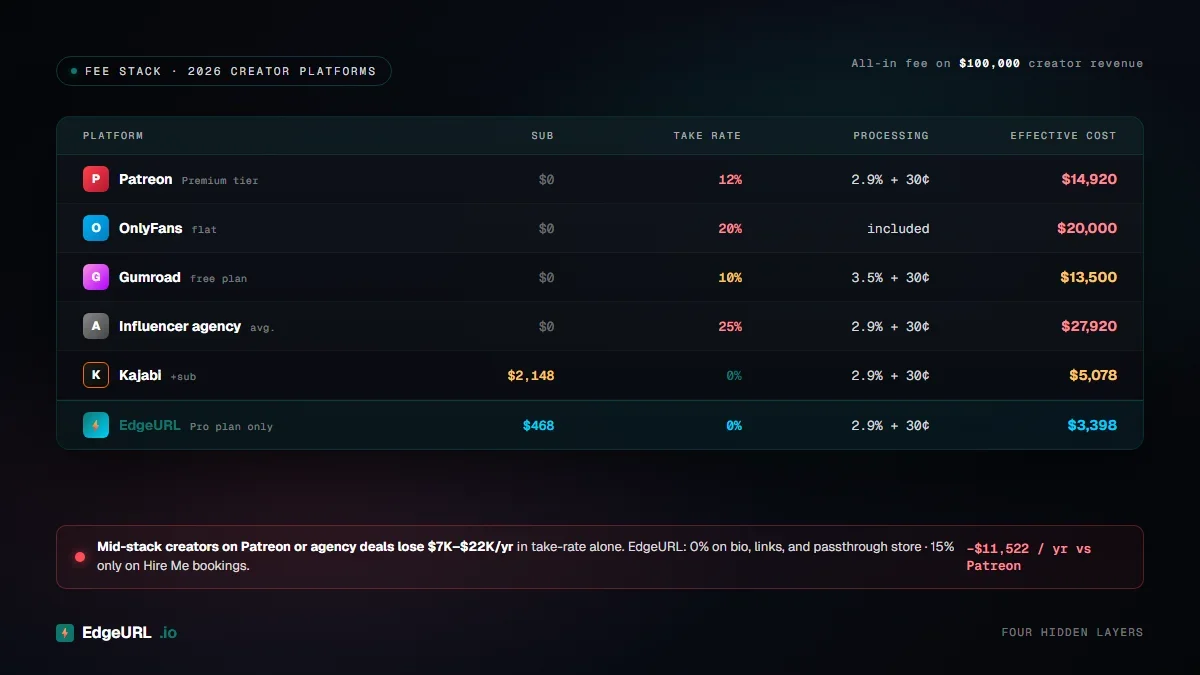
The headline subscription cost is the easy part to compare. The hidden layers — transaction fees on every sale, payment processing on top of that, payout timing that sits on your cash flow, and platform commissions that scale with your revenue — frequently double or triple the actual cost of a creator stack.
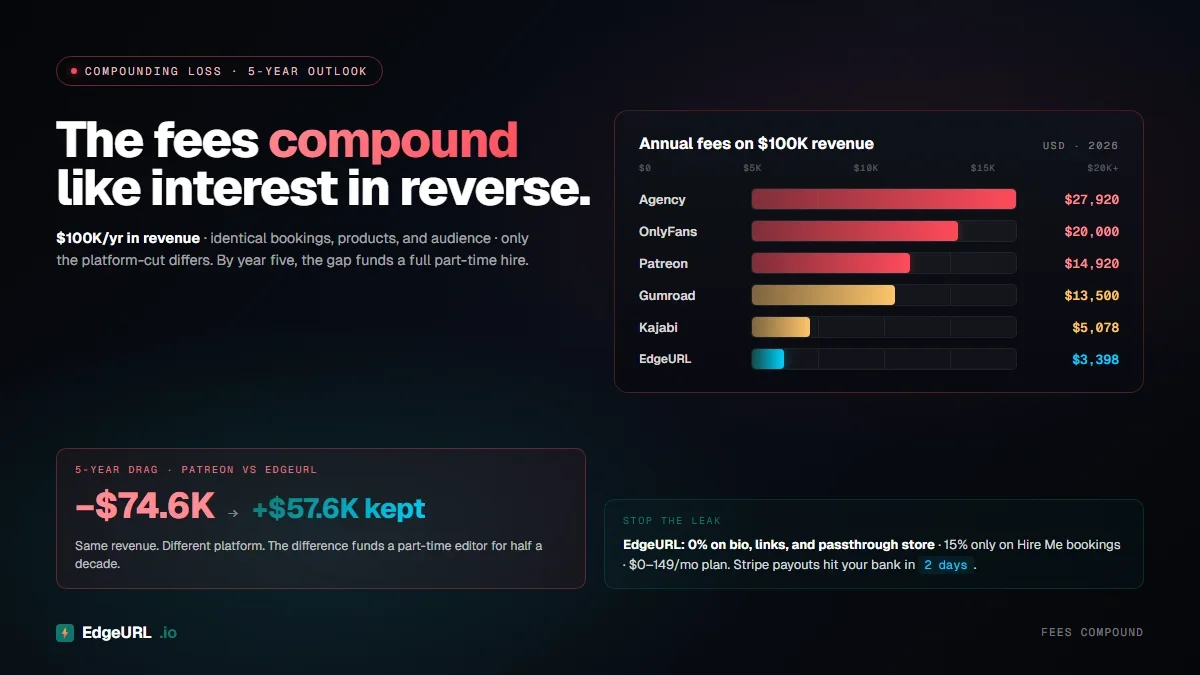
Creators consistently rank platform fees among their top concerns when choosing where to build their business, and the reason is that the fees compound. The difference between a 3% and a 15% fee structure on $100,000 of annual revenue is $12,000. That's a part-time hire, or six months of rent, or a meaningful chunk of runway extension. And most creators are paying the higher number because they never priced the alternative.
This is a long post because the fee structures are complicated. The TL;DR is at the bottom.
The four hidden layers of creator fees
When you compare creator platforms, look at these four layers, not just the monthly subscription:
1. Subscription cost
The advertised number. Patreon's tiered plans, Kajabi's monthly, Substack Pro, Beacons Pro. This is the easiest to compare and the least important.
2. Transaction fees on creator revenue
This is the per-sale percentage the platform takes. The big numbers in 2026:
- Patreon: 10% standard fee for any creator who launched after August 4, 2025; legacy creators may still be on the older Pro (8%) or Premium (~12%) tiers if they were grandfathered in
- OnlyFans: 20% flat
- Fansly: 20% flat
- Gumroad: flat 10% + $0.50 per direct sale on every account (no free vs. paid tier); 30% on Discover marketplace sales
- Ko-fi: 0% on tips, but 5% on shop sales and memberships on the free plan; Ko-fi Gold at $6/mo drops the 5% to 0%
- Kajabi: $179-$499/mo subscription plus 2.7-2.9% + $0.30 per transaction through Kajabi Payments (post-January 2026 restructure)
- Influencer agencies: 20-30%, sometimes higher
- Most creator marketplaces: 15-30% flat
3. Payment processing fees
These run on top of the platform's transaction fee. Stripe is industry standard at 2.9% + $0.30 per transaction for online card payments in the US. Some platforms wrap their transaction fee around the processing fee (so the total comes out the same), but many add it on top. Always ask which it is.
4. Payout timing
Often invisible, sometimes the most expensive. If a platform holds your earnings for 14 days before payout, you're effectively financing their operations with your cash. Compounded across thousands of transactions per year, the float on your money is real money you're not earning.
The good platforms in 2026 pay out every 3-7 days through Stripe Connect. The bad ones hold for 30 days or more.
The actual math on $100K of revenue
Run the model with two stacks. Same revenue, same product, same audience.
High-fee stack:
- Platform: 12% of $100K = $12,000
- Payment processing on top: ~3% of $100K = $3,000
- Total fees: $15,000
- Net to creator: $85,000
- Platform: 3% (or fixed monthly with no per-sale percentage)
- Payment processing: 3% (already included in many SaaS fee structures)
- Total fees: ~$3,000-$5,000
- Net to creator: $95,000-$97,000
For a creator scaling to $250K or $500K of annual revenue, the gap widens proportionally. At $500K with a 12% platform stack, you're losing $60,000 to fees. At a 3% stack, you're losing $15,000. The $45,000 difference is most of a year's rent in a major city.
Why creators don't run this math
Three reasons.
Fees feel small per-transaction. Losing 12% on a $50 sale ($6) is invisible. Losing 12% on $100,000 across the year is enormous. Humans are bad at compounding small percentages, and platforms know this.
The headline subscription cost dominates the comparison. "Free with 12% fees" feels cheaper than "$15/month with no per-sale fees" until you do the multiplication. Below ~$1,500/year of revenue, the headline number is right. Above $1,500/year, the per-sale fees dominate, and creators picking based on the monthly cost are picking wrong.
The cash flow lag is invisible. A 14-day payout window doesn't show up on any pricing page, but it's a real cost.
What "low fee" actually means
Low-fee in 2026 doesn't mean zero. Payment processing has a real cost (Stripe runs ~2.9% + $0.30) and platforms have a real cost to operate. The honest range for a healthy creator platform is:
- 0% platform fee + flat subscription, or
- 3-5% platform fee with no subscription, or
- A hybrid: small subscription + small platform fee
The 2026 alternatives:
Subscription-funded platforms charge a flat monthly rate and take 0% of your revenue on click traffic and storefront passthrough. This is the lowest-fee model for creators above a few thousand dollars in revenue. EdgeURL fits here — the Creator plan ($15/mo) and Pro plan ($39/mo) take 0% of click traffic, 0% on Creator Store passthrough, and 15% only on Hire Me bookings (creator keeps 85%).
Hybrid platforms charge a small subscription plus a small percentage. This is fine if the percentage is below ~5% and the features justify it.
Pure transaction-fee platforms at 8-30% are increasingly hard to justify above $5,000 of monthly revenue, because the math breaks down compared to the alternatives.
The "but the platform brings me audience" objection
The most common defense of high platform fees is "yes but I get discovery and audience reach in exchange". Let's check whether that's true.
For most creators on most platforms, it isn't. Patreon doesn't drive meaningful new audience — creators bring their audience to Patreon, not the other way around. OnlyFans does have a discovery layer, but it's algorithmically curated and most creators see less than 10% of their audience originate inside the platform.
The real numbers for "platform-driven audience" are usually 5-15% of new subscribers. Which means you're paying 12-20% of revenue for 5-15% of audience, and providing 85-95% of the audience yourself.
This math gets worse the bigger you get. A creator with 50,000 fans who imports them onto a high-fee platform is paying 20% on revenue from an audience they brought, in exchange for marginal new acquisition.
The honest answer: if a platform's audience-acquisition value is genuinely 20%+ of your revenue (verifiable through their analytics, not their marketing), the fee makes sense. If it's not, you're subsidizing a service you're not using.
The Hire Me model: 15% on a smaller base
EdgeURL's Hire Me takes 15% on freelance bookings. This is a deliberate choice, and worth explaining because it's not 0%.
The reason for the fee: Hire Me involves contract drafting, payment escrow, dispute resolution, and Stripe Connect — services that have real per-transaction costs. A flat 0% with no subscription would mean we lose money on every booking. We'd rather charge a fair fee than ship a feature that quietly degrades.
The reason it's 15% and not 30%: traditional freelance marketplaces (Fiverr, Upwork) carry effective take rates in the high teens to mid twenties once both sides of the platform fees are added together. We're providing the same dispute resolution and a discoverability layer through Discover, but the freelancer keeps 85%. That's better economics for the freelancer in 2026.
Compared to: Fiverr's combined ~24-26% effective take (20% seller commission plus a 5.5% buyer service fee), Upwork's variable 0-15% per-contract freelancer fee that lands near 10% on most contracts under the post-May-2025 model, or a 30% influencer agency take rate.
What to evaluate when comparing platforms
A simple checklist:
- Subscription cost per year
- Platform transaction fee % on revenue
- Payment processing fee on top (or included)
- Payout schedule (3-day, 7-day, 14-day, 30-day)
- Audit trail and dispute resolution (does the platform actually help if something goes wrong?)
- Audience attribution (does the platform drive new audience, or are you bringing your own?)
- Lock-in (custom domain support, data export, audience portability)
TL;DR
If you're earning more than $5,000/month from your creator work, the difference between a 3% and a 15% fee stack is enough to fund another month of runway every year. Run the math.
The lower-fee stack in 2026:
- A flat subscription platform that takes 0% of your revenue (EdgeURL is one option, Kajabi is another, though Kajabi added per-transaction fees in January 2026)
- A payment processor that's industry-standard (Stripe Connect)
- A booking layer that takes a fair fee for actual services rendered (Hire Me at 15%)
- A storefront layer that's passthrough rather than commission-based (Creator Store)
- 7-day or faster payouts